

Every summer it's the same shock: the July electricity bill lands and it's double what it was in May. In a Cyprus home, one thing is almost always behind that jump — the air-conditioning. But here's what the bill doesn't tell you: how much of that cost is genuinely unavoidable, and how much is just habit, an old unit, or the wrong setting. The good news is that most of it is yours to control. This guide breaks down what air-con really costs to run here, when an old unit is worth replacing, the single setting that saves the most, and the low-tech tricks that keep a Cyprus home cool on barely any cooling at all.
Quick answers
- How much does air-con cost to run in Cyprus?
- Somewhere around €0.15–0.60 an hour per unit. A modern inverter split costs roughly 15–25 cents an hour; an old non-inverter running flat out can be three to four times that. Cyprus electricity is among the priciest in Europe (~€0.28–0.34 per kWh all-in), so the hours mount up fast.
- What does a 1.5-ton non-inverter AC use per hour?
- A 1.5-ton (18,000 BTU) non-inverter unit pulls about 1.8–2.0 kW while the compressor is running — call it 50–60 cents an hour at Cyprus rates.
- What temperature should I set it to?
- 26°C. Every degree lower adds roughly 5–8% to the cost, and dropping it to 18°C won't cool the room any faster — it just runs longer to get there.
- Does cleaning it really save money?
- Yes, and it's the cheapest saving there is. A clogged filter can cost you 10–15% or more in efficiency. A ten-minute rinse each month in summer pays for itself many times over.
- Is it worth replacing an old unit?
- If it's a pre-inverter unit you lean on daily all summer, usually yes — a modern inverter uses 30–50% less energy for the same cooling and earns its keep over a few seasons.
1What air-con actually costs to run
Strip it right back and the bill is just two numbers multiplied together: how much power the unit draws, in kilowatts, and what you pay for a unit of electricity, per kWh.
The second number is the one that stings here. EAC domestic rates, once you fold in the fuel adjustment and the standing charges, land somewhere around €0.28–0.34 per kWh at the time of writing — the fuel-adjustment slice moves month to month, so treat that as a guide and check your latest bill for your own figure. Either way, it's one of the highest electricity prices in the EU. A cooling habit that's cheap in Germany is punishing in Cyprus.
The first number depends entirely on the unit, and the reason the range is so wide comes down to one word: modulation. A modern inverter eases off once the room reaches temperature, dropping to a quiet trickle to hold it there. An old non-inverter has only two settings — full-whack or off — so it spends far more of its life at the top of the table below. Stretch that difference across a long Cyprus summer and it becomes most of your bill.
Put a number on it. Run one 18k-BTU non-inverter in a bedroom, eight hours a night through July and August, and you're looking at roughly €130–150 for that one room over the two months. A modern inverter doing the identical job comes in nearer €45–70. Multiply across a three- or four-bedroom villa and you can see exactly where the summer bill disappears to. Here's roughly what an hour of actual cooling costs across the common types:
| Unit type | Power draw (running) | Cost per hour (~€0.30/kWh) |
|---|---|---|
| Modern inverter split (9–12k BTU), part-load | 0.4–0.8 kW | €0.12–0.25 |
| Modern inverter split (18k BTU), part-load | 0.6–1.1 kW | €0.18–0.35 |
| Old non-inverter (12k BTU), compressor on | 1.2–1.5 kW | €0.36–0.45 |
| Old non-inverter (18k BTU / 1.5-ton), compressor on | 1.8–2.0 kW | €0.55–0.60 |
These are estimates to show the gap between units — your real cost depends on your tariff, the room, the weather and how you set it.
2Old system vs new — when replacing pays off
Not every tired unit needs ripping out. But if you're running a genuine pre-inverter unit every day through the season, replacing it is one of the better-value things you can do to a Cyprus home. Here's how old and new compare:
| Old non-inverter | Modern inverter | |
|---|---|---|
| Running cost | Highest — full power or off | 30–50% lower for the same cooling |
| Comfort | Swings warm then cold as it cycles | Holds a steady temperature |
| Noise | Louder, clunks on and off | Quiet, runs low and constant |
| Lifespan left | Often near the end | 10–15 years typical |
| Refrigerant | May use older gas (R-22) | Modern R-32 / R-410A |
3The one setting that saves the most
This one's free, and it's the one most people get wrong. Set it to 26°C.
The instinct on a 38°C afternoon is to slam it down to 18 and wait for the cold to arrive. But air-con doesn't cool a room faster at a lower number — it simply keeps running until it hits the target, and in a Cyprus summer 18°C is a target it may never reach, so it runs flat out for hours trying. Every degree you knock off the setting adds something like 5–8% to the running cost.
26°C is genuinely comfortable in dry Cyprus heat and — crucially — it's a temperature an inverter can hold on a trickle rather than a roar. A few habits stack neatly on top:
- •Use "cool" mode, not "auto." Auto can quietly flip to heating, or over-cool the room.
- •Leave the fan on auto and point the louvres up — cold air falls, so you want it thrown high.
- •Don't switch it off for a quick errand. An inverter ticking over at 26°C costs less than dragging a baked room back down when you return. (Gone for the whole day, though? Off wins.)
- •Cool the rooms you're in. Bedrooms at night, living room by day — zoning beats cooling the whole house around the clock.
4Cleaning and maintenance — the cheapest win there is
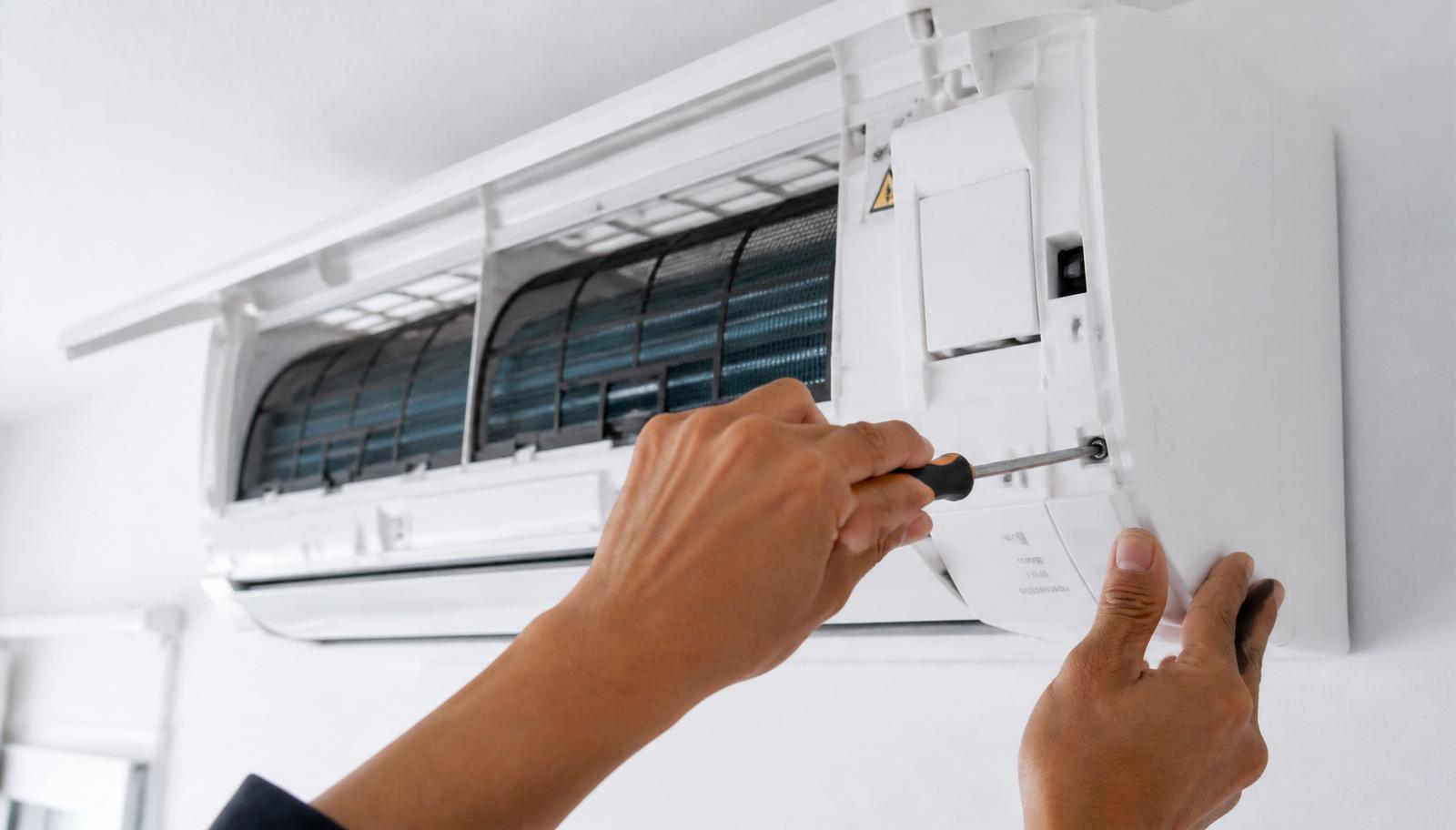
A dirty unit works harder to shift less cool air, and you pay for that difference every single hour it runs. Pound for pound, this is the highest-return thing on the whole list.
Start with the filters — rinse them monthly through summer. Pop the front cover, slide out the mesh filters, rinse under the tap, dry, refit. Ten minutes, and a clogged filter can quietly cost you 10–15% or more in efficiency while pushing dust around the room. In a dusty Cyprus summer they clog fast.
Once a season, go deeper. The indoor coil and the outdoor unit's fins gather a film of dust and grime that insulates them and throttles heat transfer — a proper clean brings the cooling back. And keep that outdoor unit clear and shaded: its whole job is to dump heat, so it loathes sitting in full afternoon sun against a hot wall with no air moving around it.
Two things worth a technician's eye. If a unit runs constantly but never quite gets cold, it's usually low on refrigerant — a leak, not old age — and topping it up costs a fraction of replacing the unit. And a yearly service before the season starts catches all of the above and keeps everything running efficiently for years. It's a small annual outlay against a very large seasonal bill.
If your home also battles hard water and weak plumbing when the heat arrives, the same "maintain it before it costs you" logic applies — we cover that in our guide to fixing Cyprus water-pressure problems.

5"Dead-stop" cooling — using almost no air-con at all
The cheapest air-con is the hour you never switch on. Cyprus homes — especially older stone and block builds with proper shutters — can be kept genuinely comfortable with barely any cooling, if you work with the day instead of fighting it. This is how the island kept cool long before every room had a split unit.
Shut the heat out before it gets in. Close the shutters and curtains on the sunny side of the house in the morning, before the sun swings round to them. Keeping the sun off the glass is worth more than any amount of cooling once the room's already hot — and external shutters and awnings beat internal blinds, because they stop the heat at the window rather than after it.
Then flush it out at night. Cyprus evenings cool right down. Throw the house open overnight to purge the day's heat, then shut it all up first thing before the temperature climbs again. A home closed to the day and opened to the night stays remarkably cool on its own. Open windows on opposite sides for a through-draught while you're at it — a breeze moving over you feels several degrees cooler even when the thermometer hasn't budged.
And lean on fans. A ceiling or pedestal fan costs cents a day, not euros an hour, and moving air makes 28°C feel like 25. For much of the season a fan alone does the job; on the fiercest days, a fan plus the AC at 26°C lets you set the unit higher and still feel cool. Two last habits: cook and dry outside where you can — the oven, hob and tumble-dryer all pump heat into the house at the worst possible moment — and shade the outside with pergolas, plants and a covered terrace, which is exactly why the old Cypriot houses were built with deep, shaded verandas.
Do even a few of these and many homes only reach for the air-con on the truly brutal afternoons and to sleep. That's where the real savings live. There's more in our villa cooling tips for a Cyprus summer.
6Controlling air-con in a rental: the options
If you let your property, air-con becomes a live problem, because guests run it nothing like an owner does — all day, doors flung open, dialled down to 18°C. You're footing the bill and you're not there to touch the controls. The real question is how much control you actually want, and the answers run from free-and-trusting to fully automated. Here's how the main options stack up:
| Option | How it works | Rough cost | Pros | Cons |
|---|---|---|---|---|
| Guest guidance card | A laminated note by each unit — "set to 26°C, close the doors and windows when it's on" | A few € to print & laminate | Free; no kit; guests mostly play along when it's framed as comfort, not penny-pinching | Runs entirely on goodwill; nothing to enforce it |
| Hotel-style key-fob switch | Power to the room only works with the fob in a holder by the door; pull it out on the way out and everything cuts | Hardware €20–60/room, but the real cost is the install — €150–350+/room to wire the AC circuit through a contactor and run control cabling in a finished building | Kills the AC (and lights) whenever the room's empty; guests already know the drill | Costly and disruptive to retrofit — chasing walls and making good per room; defeated by any old card left in the slot; can cut the fridge or router if wired to the whole room; really only makes sense wired in at build, in aparthotel-style room lets, not whole villas |
| Smart WiFi controller (Sensibo, Tado, Cielo…) | A small IR device drives your existing unit; you set a minimum temperature and schedules from an app, and switch it off between bookings | €70–120/unit (some features need a subscription) | Set a floor so it can't drop below, say, 23°C; schedule; monitor and kill it remotely; uses the AC you already own | Needs reliable WiFi; guests can still nudge it within your limits |
| Occupancy / motion sensor | Switches the AC off automatically once a room's sat empty for a set time | €20–50/sensor (or built into some smart controllers) | Catches the classic "blasting away, nobody home"; needs nothing from the guest | False switch-offs — a still or sleeping guest trips it — which turns into comfort complaints if you set it too keen |
| Door / window contact sensor | Cuts the AC the moment a balcony door or window is left open | €15–30/opening | Stops the single biggest waste of the lot — cooling the great outdoors; pairs neatly with a smart controller | Hardware on every opening; guests baffled when the AC "stops working" |
| In-unit temperature lock | Many units let you cap the minimum in the settings or remote menu | Free (built into the unit) | No extra kit at all | Not every unit supports it; a factory reset or a spare remote quietly undoes it |
The short version
Air-con is the biggest line on a Cyprus summer bill, but almost all of it is yours to control. Set it to 26°C, rinse the filters monthly, replace genuinely old non-inverter units, and lean on shutters, night air and fans so you're only cooling when you truly need to. Do all of that, and the July bill that used to make you wince becomes a number you can plan around.
Disclaimer
Cost figures in this guide are estimates to illustrate the difference between systems and settings. Cyprus electricity tariffs move with EAC's monthly fuel adjustment, so your own rate — and your bill — will vary; check your latest statement for the figure that applies to you.
Any work that touches mains wiring — key-fob switches, hard-wired controllers or contactors — should be carried out by a licensed Cyprus electrician.
Last reviewed: July 2026.
Frequently Asked Questions
Want to know more about the author?
Meet DemetriShare This Article
Continue Reading

Boost Your Home's Appeal: 5 Ways to Add Value to Your Cyprus Property
Smart improvements that dramatically increase your property's value and appeal.
Read More
Paphos for Families: A Guide to Fun with Your Little Ones
Discover why Paphos is the perfect family destination with activities, beaches, and attractions for children.
Read More
A Local's Guide to Paphos on a Budget: 7 Tips for a Cheaper Holiday
Discover insider secrets to enjoying Paphos without breaking the bank.
Read More